
Financial institutions have always relied on data. However, the sheer amount of information they collect today is unprecedented. To stay competitive in the modern market and grow your business, it is crucial to know how to use these volumes of data to your advantage. That’s why financial companies choose big data services to tap into deep analytical insights and revamp operations.
Big data analytics in finance helps businesses to improve credit scoring and asset management processes, assess risk more accurately, enhance fraud detection, and level up customer service. This article explains the key applications and trends of big data analytics in finance, along with the benefits, challenges, and real-life examples of how to apply this technology.

The role of big data in finance
Big data analytics is a collection of techniques used to process and analyze vast amounts of information. It incorporates machine learning, predictive analytics, data mining, and natural language processing to identify patterns, relationships, and insights that traditional methods often overlook.
The financial sector is one of the most data-driven industries. Traditionally, financial analysts have long used statistical models, spreadsheets, and reporting tools. However, with the rise of digital banking, the amount of information the sector generates today has become enormous. In the modern financial sector, data comes from various sources and greatly varies in format. It’s not just transactional data and account statements, but also:
- Social media activity
- Exchange rates
- Stock prices
- Demographics
- Spending habits and preferences
- Investment activity
Analyzing such massive datasets using conventional methods is impractical. Given the rapidly changing financial landscape, the ability to process information in real time is now a necessity. This is now possible due to the implementation of big data analytics.
Big data analytics in finance: statistics
According to Research and Markets, the big data analytics market size in banking, financial services, and insurance (BFSI) will grow from $35.43 billion in 2026 to $62.5 billion by 2030 with a CAGR of 15.5%.
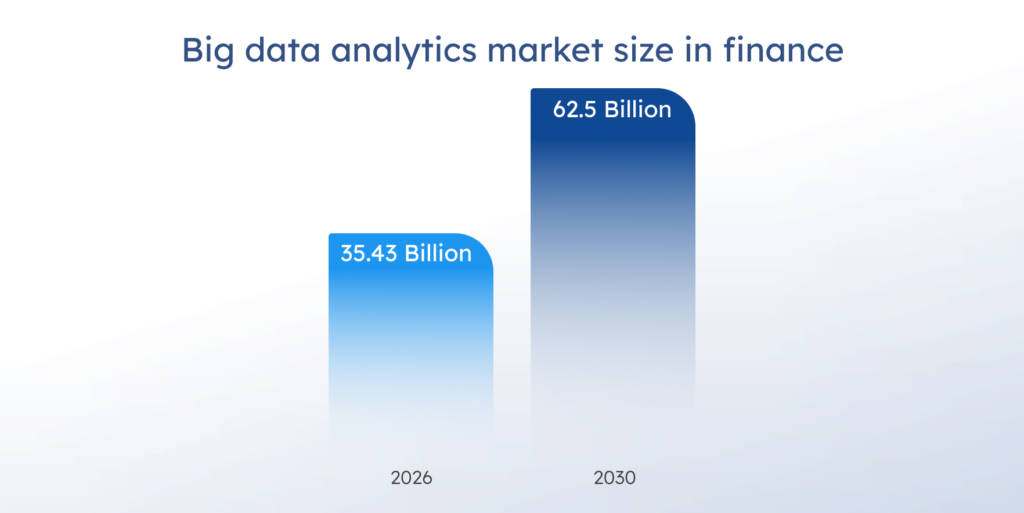
The big data analytics market size in BFSI. Source
The BFSI sector holds the largest share of the global big data analytics market in 2026, accounting for 22.31%. Healthcare ranks second with approximately 17%, telecom and media takes third place with around 16%.
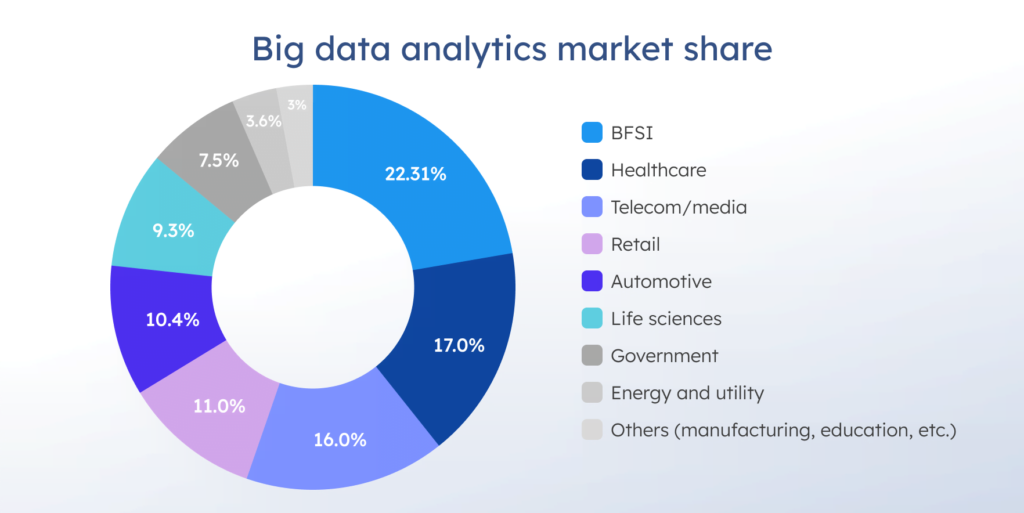
Global big data analytics market share across industries. Source
Investments in big data technologies also vary across the financial sector. Personal and business banking ranks first with approximately 29%, insurance services second with 28%, and asset and wealth management third with 13%.
Beyond investing in infrastructure, financial companies focus on using different types of data analytics to gain business value. 85% of organizations use business analytics, while 65% use predictive analytics and 40% use prescriptive analytics.
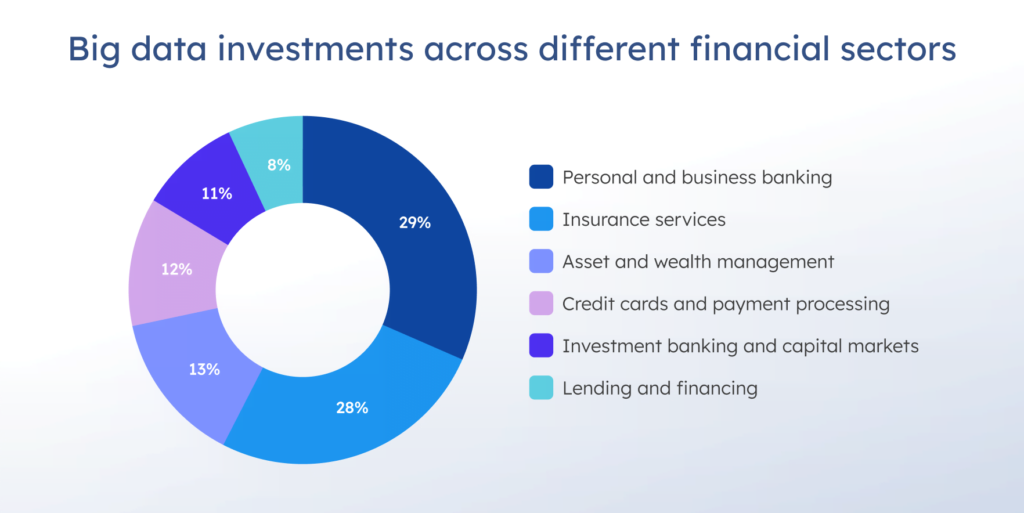
Investments in big data by the financial sector. Source
In regard to the benefits of big data, financial companies rank nowcasting first at 55%, forecasting second at 55%, and stress testing third at 42%.
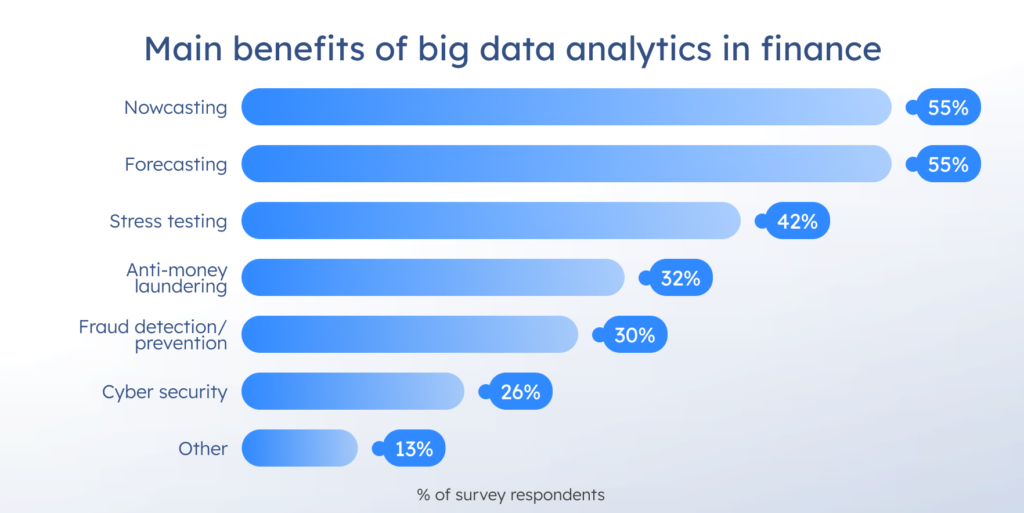
Benefits of big data analytics in finance. Source
Big data analytics has also delivered measurable improvements in operational outcomes. Real-time financial data processing in leading banks has delivered up to 20% fraud-loss reduction via AI-powered analytics. The use of analytics showed the highest impact on decision making, with a score of 4.6 out of 5. Finance saw a 33% reduction in decision-making time, dropping from 12 to 8 hours after implementing BA tools.
Also, financial firms have reduced costs by 15% to 35% depending on the specific industry segment. In transactional finance processes, companies achieve efficiency improvements of 39% largely supported by automation and advanced analytics.
Data types used for financial analytics
The financial industry generates vast amounts of data from diverse sources. Getting the most out of them requires proper processing and analysis. This is achieved through the use of various types of data.
Structured data has a standardized format and consists of rows and columns, such as names and phone numbers. This type of data is generally easier to process, but it still requires consistent formats, quality checks, and integration with banking systems. Examples include:
- Transactional data: deposits, withdrawals, transfers, credit/debit card usage.
- Customer account information: account balances, loan details, credit limits.
- Market data: stock prices, exchange rates, interest rates.
- Regulatory and compliance records: KYC (Know Your Customer) data, tax filings.
Semi-structured data is not stored in a traditional relational database but still possesses some organizational properties, such as tags or markers. It is easier to analyze than unstructured data but less strictly organized than structured data. For example:
- CRM exports: customer profiles, purchase history, segmentation data.
- Bank emails: correspondence with clients, regulators, other banks.
- API data feeds: fintech integrations, payment gateways.
- Social media interactions: tagged feedback, brand sentiment.
Unstructured data lacks a predefined, structured format, so it cannot be easily organized or analyzed. AI-powered technologies such as natural language processing (NLP) and computer vision help teams uncover insights from unstructured datasets. Examples involve:
- Customer service transcripts: call center recordings, chat logs.
- Document scans: loan applications, contracts, ID verification files.
- Images and video: ATM surveillance, branch CCTV.
- News articles & financial reports: market commentary, earnings reports, regulatory filings.
Real-time/streaming data is collected, processed and changed constantly for immediate insights that make them difficult to handle. To simplify this process, companies can use stream processing frameworks, event-driven architectures, and real-time data processing systems. The examples of such data type are:
- Live transaction streams: real-time fraud detection and compliance monitoring.
- Stock market tick data: high-frequency trading analytics.
- IoT sensor data: ATM status, branch traffic sensor readings.
- Payment processing data: instant approvals, declines, fraud triggers.
Applications of big data analytics in finance
Big data has become an indispensable tool for financial organizations due to a range of diverse and beneficial use cases, which we will consider further in depth.
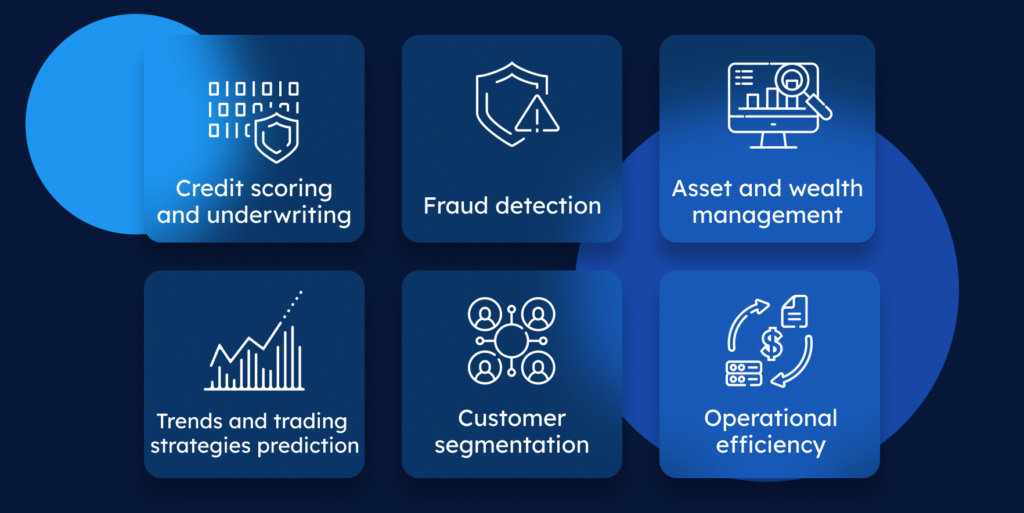
Credit scoring and underwriting
Traditionally, credit scoring relied heavily on historical financial data and a few standardized metrics. Big data analytics has transformed this process by incorporating a wider array of data points, including social media activity, and online behavior. By analyzing these data inputs, financial businesses can create more nuanced credit profiles and assess an individual’s creditworthiness more accurately.
For example, financial companies can use machine learning algorithms to analyze unconventional data, resulting in higher approval rates for credit applicants who may have been overlooked by traditional models. Based on this data, bank workers can make more informed decisions on whether to approve or reject a loan application.
Fraud detection
Financial organizations work with highly sensitive data, so it’s no surprise that fraud activity is pretty high there. The number of fraud attempts has increased by 60% over the past year. Big data analytics helps banks to respond to them more effectively. Machine learning models can analyze historical and real-time data and identify suspicious activities or unusual customer behavior. Therefore, organizations can mitigate risks and employ strong anti-fraud measures.
For instance, two transactions from one credit card were made simultaneously or within a short time frame in two different cities. The bank can react immediately and inform the client about the unusual activity and security threats. They can even block the transaction and the card as a preventive measure.
Asset and wealth management
Big data gives asset and wealth managers a broader view of investment opportunities and risks. Investment managers and advisors can use AI-powered wealth management tools with data analytics to evaluate the performance of their current assets against market trends and changes, as well as to test different investment strategies. This helps them create personalized investment strategies, make better decisions, and ensure effective portfolio management. 73% of asset and wealth managers claim that AI will become the most transformative technology in the next 2–3 years, and they expect to see a 12% boost to revenues by 2028.
For example, machine learning algorithms can process and analyze historical data and market trends to identify potential investment opportunities that human analysts might overlook. With big data analytics, financial managers can improve their predictions as new market data becomes available, reducing investment risk over time.
Customer segmentation and personalization
Among varied big data applications in finance, customer segmentation is one of the most prominent. Traditional methods of segmentation used to rely on demographic factors like age, income, and location. However, big data enables financial firms to analyze a multitude of variables, including customer purchasing behavior, online interactions, and social media activity.
For instance, banks can use data analytics to identify specific groups of customers who may be interested in particular financial products. By examining transaction histories and customer feedback, they can create detailed profiles that allow for more targeted marketing strategies. This improves customer satisfaction, boosts conversion rates, and establishes long-term customer relationships.
Market trends and trading strategies prediction
Big data analytics is actively used to predict market trends and trading strategies. By analyzing vast datasets, price history, market news, and social sentiment, financial specialists can gain valuable insights into market trends. In trading, people can also analyze past prices, real-time trading data, market volatility, news, and social media data to find good times to buy and sell. Traders can use ML models to test and refine financial strategies in real time, helping lower risk and increase the likelihood of profit.
For example, an ML model might detect that stocks often increase after positive news and social media activity. Then, a person is likely to use this signal to decide when to buy before the price rises or not.
Operational efficiency
The financial sector is notorious for its complex and often cumbersome processes. Businesses can use big data to track financial metrics, such as revenue, expenses, and profits. By analyzing them, financial enterprises can gain a deeper understanding of their operations and implement strategies likely to drive revenue growth. Additionally, businesses can identify back-office optimization opportunities (e.g., loan processing, fraud detection), automate repetitive tasks, and reduce operational costs.
For instance, financial companies can use predictive analytics to forecast cash flow needs, enabling them to manage liquidity more effectively. They can also spot potential problems in operational workflows early on, allowing teams to iron out inefficiencies and fix up processes before they start to drag down performance.
Key benefits of big data analytics in finance
Big data analytics offers numerous benefits to the finance industry. Let’s consider them in depth.
1. Fast and more accurate decision-making
Big data analytics enables financial institutions to bring together structured and unstructured data in real time, allowing for deeper and more accurate analysis. This helps 70% of financial organizations improve their decision-making process, 71% of them speed it up and develop more profitable investment strategies.
2. More personalized customer experience
In fact, 72% of customers think that personalization is “highly important” in financial services. When your finance organization provides personalized financial products, services, and support, customers are more likely to choose them again. That’s how you can improve long-term customer relationships and loyalty.
3. Reduced financial threats
Financial companies lost $60 million to payment fraud during 2025. Through advanced algorithms and data mining techniques, financial firms can identify anomalies and suspicious activities in profiles, prevent them as fast as possible, and minimize cases of financial attacks and losses in the future.
4. Personalized financial products
More than 46% of U.S. consumers want personalized financial product offers, while 45% expect tailored financial insights based on spending behavior. By analyzing customer data, including spending habits, preferences, and financial history, financial institutions can tailor their offerings to meet the unique needs of individual clients, improving their loyalty and engagement.
5. Risk mitigation
Big data analytics is going to reach $66.37 billion in 2026 largely due to risk management and fraud prediction use cases. By predicting market trends and mitigating possible financial risks, companies can better understand potential market volatility, adjust their strategies, and take necessary steps to minimize financial risks before they worsen.
6. Strong regulatory compliance
By providing greater visibility into transactions, customer activities, and reporting processes, big data analytics helps financial firms identify potential compliance issues early and stay aligned with regulations such as GDPR, CCPA, and anti-money laundering (AML) requirements. This helps reduce the risk of non-compliance, and avoid financial penalties.
7. Cost savings
By analyzing large datasets, financial institutions can spot avoidable costs, streamline operations (underwriting or compliance checks), and prevent expensive downtime or data breaches. This, in turn, leads to reduced operating costs along with improved overall efficiency and productivity.
Technologies driving big data analytics in finance
Big data on its own doesn’t deliver value. It works well only when it is tightly integrated with supporting technologies such as cloud computing, AI, NLP and advanced analytics tools.
AI and machine learning
Artificial intelligence and machine learning are the main driving forces behind the advancements of big data analytics in finance. They enable financial organizations to process and analyze massive datasets with remarkable speed and precision, uncovering patterns and insights that would otherwise go unnoticed.
AI and ML facilitate a wide range of applications in the financial sector, such as:
- Predictive analytics
- Fraud detection
- Customer personalization
- Risk assessment
Cloud computing
Cloud computing allows financial organizations to manage and safely store their massive datasets. One of its primary advantages is scalability. Companies can access virtually limitless storage, which allows them to handle fluctuating data volumes without investing in on-premise infrastructure. This flexibility is particularly beneficial when data demands increase during periods of market volatility.
Transitioning to the cloud also offers cost savings. Traditional data centers require substantial investments in hardware and maintenance. In contrast, cloud services operate on a pay-as-you-go model, allowing firms to allocate resources more effectively.
NLP
Natural language processing (NLP) enables financial companies to better analyze and manage the vast amounts of text data they generate daily. NLP offers precise methods to extract relevant information from text sources. Paired with ML, it helps firms derive sentiment from social media, automate compliance and document review, and improve credit risk assessment by analyzing unstructured customer data.
Challenges of big data analytics in finance
Although big data analytics brings a lot of benefits for the financial sector, providing valuable insights into consumer behavior, enhancing risk management, and fraud detection, there are several challenges that companies may face.
Data security and privacy
In the finance industry, the stakes are incredibly high when it comes to data security. Financial organizations handle vast amounts of sensitive information, from personal identification details to transaction histories. Therefore, they need to ensure robust security measures while maintaining user privacy. A breach not only compromises customer trust but can also lead to significant financial losses.
Regulatory and compliance issues
The financial sector is one of the most regulated industries globally, with stringent rules and guidelines designed to protect consumers, maintain market integrity, and prevent systemic risks.
Ensuring compliance with evolving regulations requires robust data governance frameworks. These frameworks should encompass data quality, lineage, and accessibility standards. As financial institutions collect and analyze data from various sources, maintaining a clear understanding of data origins and transformations can be challenging.
Integration complexity
Many banks and financial businesses still rely on legacy systems that lack the flexibility for sophisticated analytics. Integrating these systems with new technologies, such as cloud computing and machine learning algorithms, becomes complex, especially when data is pulled from different sources. This often leads to challenges with data consistency and quality, including duplicated records, mismatched formats, and outdated information. To ensure seamless data flow across systems, companies need continuous data validation, cleansing, and synchronization processes.
Data silos
Banks and other financial firms store large amounts of data across different systems and departments. The inability to use it leads to data silos, which become a major challenge. It makes it difficult to access information and to conduct a comprehensive analysis. To resolve this issue, companies need to create centralized data repositories, standardize data formats, and establish data governance frameworks.
Skill gap
Even though the importance of big data analytics is quite evident, the financial sector is in dire need of skilled specialists. The thing is, data science is a difficult field, and data analysts need a particular set of skills, such as proficiency in programming, statistical analysis, and data visualization. Data analysts must also be adept at working with various data management tools.
An additional complication is that financial establishments require specialists who possess not only technical skills but also understand the complexities of the finance sector, such as market trends, regulatory rules, risk management, and investment strategies. As a result, it’s quite a challenge to find and hire a good specialist.
Data quality
If the quality of your data is poor, so are the insights you retrieve from it. As we mentioned earlier, the sources of financial data, as well as their formats, are quite diverse. Up to 90% of this data is unstructured and difficult to analyze, which can lead to misguided business decisions. This makes maintaining the high quality and consistency of the information across all these sources a critical concern.
Real-life examples of using big data analytics in financial
Many financial businesses benefit from big data analytics around the world. Here are a few examples.
Visa: fraud prevention
Visa, a multinational payment card services corporation, processes more than 0.8 billion of transactions daily. It uses ML models to regularly analyze large datasets, like transaction patterns, device fingerprints, and behavioral biometrics, to detect suspicious activity. For example, if a frequent customer suddenly makes several large purchases from a new country at 3 a.m., this could signal an account takeover. The system could automatically block, confirm, or escalate the transaction.
With the use of ML models that are fed real-time data from across payments and data analysis, the company can identify emerging fraud patterns instantly. The results are enhanced detection accuracy, reduced false positives, and stronger financial protection.
Capital One: fraud and anti-money laundering (AML) prevention
Capital One, one of the largest banks in the United States, uses machine learning, data, and a customer-centric approach to analyze large amounts of data, which helps it detect and prevent fraud in real time. The financial company also uses a proactive intelligent assistant called Eno. It automatically alerts customers to potential fraud in real time and, if necessary, can recommend locking their card.
Capital One also uses data and ML to prioritize suspicious activity in anti-money laundering investigations by comparing customer behavior to historical patterns. This approach increases the efficiency of crime detection and helps investigators focus on the most risky situations. Thus, the company improves customer service and banking operations through effective fraud-prevention systems.
Wells Fargo: customer segmentation and personalization
Wells Fargo, one of the major banks in the US, has implemented a big data-driven strategy for client segmentation. The bank collects data from various sources to build a comprehensive customer profile. Then, it uses ML algorithms and data analytics systems to process and
analyze these datasets. Through the use of big data algorithms and predictive analytics, such as K-means clustering techniques, Wells Fargo groups clients with similar characteristics, estimates future behavior, and finds areas for targeted marketing.
As a result, the bank increased customer retention by 30%, cross-selling opportunities by 25%, improved satisfaction, and increased competitiveness in the market.
Goldman Sachs: algorithmic trading and market prediction
Goldman Sachs, an American investment bank and financial services company, uses big data analytics to generate market data feeds, trading tools, and client-focused products. For example, the company uses traditional financial data, market data, and non-traditional data sources (e.g., internet traffic and patents) to analyze large, publicly traded companies and make more informed investment decisions.
Goldman Sachs uses big data analytics in algorithmic trading to analyze large volumes of real-time and historical market data. The company applies data-driven algorithms to optimize order routing, identify liquidity, improve trade execution, and reduce latency. It also uses analytics to measure trading performance and customize strategies for clients.
JPMorgan Chase: investment risk modeling and customer insights
JPMorgan Chase, a major US financial services company and one of the largest banks in the world, actively uses big data analytics to process massive volumes of customer and financial data. This analysis helps the firm determine which financial products are best suited to a specific client, assess creditworthiness and financial risks, detect fraud/cyber threats, and predict market opportunities. But the primary goal is to provide the right product to the right customer at the right time through the most suitable communication channel.
An overview of big data analytics tools
Big data analytics tools are vital as they help organizations process massive datasets, identify patterns, and make data-driven decisions without requiring deep technical expertise. But selecting the right ones is tricky, as the choice depends on your cloud ecosystem alignment, workload type, governance requirements, and whether you need batch or real-time processing. Here are some key features to look for in an analytics tool:
- The ability to handle large volumes of data. Look for high-performance computing capabilities that can scale with your business as data volumes grow without sacrificing performance.
- Data visualization capabilities. Make sure you choose the tool with data visualization functionality (graphs, charts, or dashboards) so you can present the data in a more digestible and actionable way.
- Intuitive interface and ease of use. Choose a tool with a user-friendly interface and intuitive features like customizable dashboards, drag-and-drop options, and clear reporting. Therefore, it will be easier for your team to master and use the tool efficiently.
- Seamless integration and compatibility with existing infrastructure. Ensure that the analytics tool can integrate seamlessly with your existing systems and tools, such as CRM platforms and cloud and data storage solutions.
- Robust security features. With the increasing risk of data breaches, it is critical to choose a tool that offers robust security features, including encryption, access controls, and compliance with industry regulations to protect your data.
- Cost-efficiency. Define your needs and budget first, then evaluate tools accordingly. Many offer free or low-cost plans, but their functionality may be limited. Always review pricing structures carefully to ensure they match your requirements.
- Collaboration features. You may need to share your insights with stakeholders or have different teams working on the analysis and report. It’s better if the tool has the ability to share the reports, dashboards, or data sets in real time.
Some of the popular tool choices for big data analytics in finance to consider:
Apache Spark
Apache Spark is an open-source analytics engine recognized for its speed and ease of use. It offers in-memory data processing, which significantly enhances performance. Additionally, the platform includes several libraries for SQL queries and user-friendly APIs that simplify data retrieval.
MongoDB
MongoDB is a NoSQL database for handling large volumes of unstructured or semi-structured data. It is highly scalable, flexible, and categorizes documents into collections with key-value pairs. It is widely used for content management, real-time analytics and supports multiple programming languages, including Python, Ruby, and JavaScript.
BigQuery
BigQuery is a managed serverless data warehouse provided by Google Cloud. With its robust built-in features like machine learning, business intelligence, and geospatial analysis, the platform helps users process and analyze vast datasets. It is highly scalable and cost-efficient; its pricing is based on the amount of processed data or a flat-rate option for predictable pricing.
Snowflake
Snowflake is a cloud-based data warehouse that securely stores large volumes of data and separates storage from compute for flexible, independent scaling. All data is stored in one place and accessible to all compute nodes, but each node processes data independently. Overall, Snowflake is easy to use and also provides multi-cloud support.
Power BI
Power BI helps transform raw data into interactive visualizations. It seamlessly integrates with other Microsoft services like Azure or Office 365, as well as with various data sources, such as Excel, cloud services, and SQL databases, fostering collaboration and real-time data analysis. It has a user-friendly interface and is easy to use for non-technical users.
Tableau
Tableau empowers businesses to interpret and transform raw data into easy-to-understand visualizations. It has a drag-and-drop functionality, which makes it accessible for users with different technical skill levels. They can conduct real-time data analysis and create compelling, shareable dashboards. Overall, Tableau is a great tool for business intelligence and collaborative work.
If you are interested in Tableau and Power BI but don’t know which one to choose, you can check our Power BI vs Tableau comparison article.
How big data analytics is changing the future of finance
Big data analytics isn’t just a trend in finance – it’s a must-have for any institution that wants to keep up. With markets moving faster than ever, banks and investment firms need real-time insights to make smart decisions, manage risks, and give customers more personalized services. AI and predictive analytics are already changing the game, helping innovative firms spot trends before they happen. Moreover, institutions that build their decisions on data will be able to stay stable in uncertainty, move faster than competitors and respond more effectively to regulatory and market shifts.

Future trends in big data analytics in finance
The financial sector continues to embrace digital transformation, continually finding new ways to use big data analytics for financial services. And given the technological advancements of recent years, the future looks promising.
Blockchain in financial data management
Blockchain technology has great potential in big data analytics. It ensures transparency of financial operations, allowing all parties in cash flow transactions to view the same data. The decentralized nature of blockchain, paired with predictive analytics, can help to enhance security measures and fraud detection. Not to mention, blockchain employs cryptographic techniques to secure data, making it resistant to tampering and unauthorized access.
Moreover, blockchain technology supports smart contracts – self-executing contracts whose terms are directly written into code. These contracts automate processes and reduce the need for intermediaries, streamlining transaction operations.
AI-powered technologies
Financial organizations are increasingly adopting AI technologies to analyze vast datasets, uncover patterns, and make data-driven decisions. Machine learning algorithms can predict market trends, assess credit risk, and even enhance customer service through chatbots.
Moreover, AI’s ability to process unstructured data, such as social media sentiment or news articles, enables financial analysts to gain insights that were previously difficult to capture. And it will only improve from there, as AI and machine learning are constantly evolving. Companies like BlackRock are already leveraging AI to optimize investment strategies, demonstrating the immense potential of these technologies.
Environmental, Social, Governance (ESG) data analytics
As sustainability becomes a pressing global concern, the importance of ESG data analytics in finance is on the rise. ESG factors are playing an increasingly important role in investment decision-making, leading to the development of tools that analyze corporate performance based on these criteria.
Big data analytics enables financial institutions to evaluate ESG risks and opportunities more effectively. For example, companies can use data analytics to assess their carbon footprint and analyze supply chain practices, and employee diversity. With this information, they can align their strategies, making them more sustainable and appealing to investment.
Conclusion
Big data analytics in finance works best when it is tied to specific business goals, such as improved fraud detection, risk scoring, compliance reporting, personalization, or operational efficiency. However, technology alone is not enough. Financial institutions also need strong data infrastructure, proper governance, integration with legacy systems, and specialists who understand both data science and financial workflows.
Alternatively, you can collaborate with experienced big data service providers, such as SoftTeco, who help you design, implement, and scale analytics solutions that align with regulatory requirements and real business needs. Contact us to get a free consultation on how to make your big data work for you.






Comments